


Technical Standards in Stone Curtain Wall Design and Installation
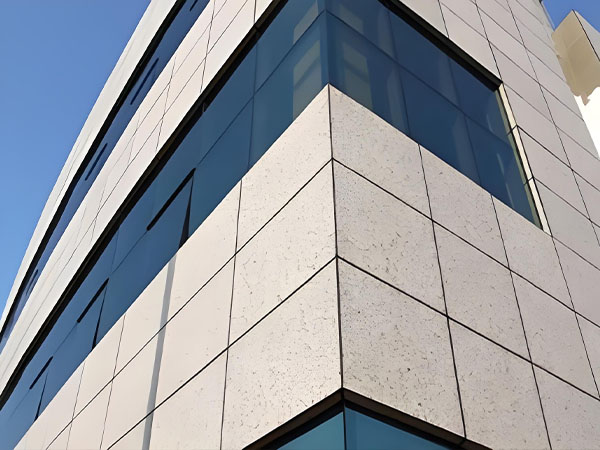
Stone curtain walls have become a preferred architectural solution for their durability and aesthetic qualities in modern building construction. The design and installation of these systems require strict adherence to technical standards to ensure structural integrity, weather resistance, and long-term performance. This article examines the key technical standards governing stone curtain wall systems, focusing on material specifications, structural requirements, and installation protocols.
Material Specifications and Testing
1.Stone Selection Criteria
Natural stone must meet ASTM C615, C616, or C629 standards for dimensional stability and mechanical properties
Minimum thickness requirements typically range from 25mm to 30mm for granite and 30mm to 40mm for marble
Water absorption rates should not exceed 0.4% for exterior applications
2.Anchorage Systems
Stainless steel anchors must comply with ASTM A276 for corrosion resistance
Mechanical properties should meet minimum tensile strength of 515MPa
Anchor design must accommodate thermal movement differentials between stone and supporting structure
3.Supporting Framework
Aluminum substructures must conform to AA-6063-T5 or T6 standards
Steel supports require hot-dip galvanizing per ASTM A123 for corrosion protection
Deflection limits of L/175 under wind load and L/250 under dead load
Structural Design Requirements
1.Load Considerations
Wind load calculations based on ASCE 7-16 requirements
Seismic design per ASCE 7-16 chapter 13 for seismic force-resisting systems
Differential movement accommodation of at least ±5mm for typical installations
2.Connection Design
Minimum safety factor of 2.5 for all primary connections
Redundancy in anchorage systems with no single-point failures
Provision for three-dimensional movement capability in all connections
3.Interface Details
Minimum 6mm joint width between stone panels
Proper drainage provisions with weep holes at maximum 600mm centers
Backer rod and sealant joints designed for 25% movement capacity
Installation Quality Control
1.Pre-Installation Verification
Substrate tolerance verification within ±3mm over 3m span
Mock-up panel approval prior to full installation
Material batch testing for color and texture consistency
2.Installation Tolerances
Panel-to-panel alignment within ±1.5mm
Overall facade flatness within 6mm over 3m
Vertical alignment within 3mm per story height
3.Performance Testing
ASTM E283 air infiltration testing at design pressure
ASTM E331 water penetration testing at 20% over design pressure
Structural load testing per project specifications
Maintenance and Inspection Protocols
1.Periodic Inspection Requirements
Annual visual inspections of sealant joints and anchors
Five-year comprehensive inspection including non-destructive testing
Immediate inspection following extreme weather events
2.Common Deficiency Identification
Crack detection using borescope examination of anchor pockets
Sealant adhesion testing per ASTM C794
Anchor corrosion assessment through selective removal
3.Repair Methodologies
Crack repair using epoxy injection for structural cracks
Sealant replacement following ASTM C1193 guidelines
Anchor replacement procedures maintaining load transfer continuity

Conclusion
The successful implementation of stone curtain wall systems depends on rigorous application of established technical standards throughout design, installation, and maintenance phases. By adhering to material specifications, structural requirements, and quality control protocols, these systems can achieve their full potential in terms of durability and performance. Continued refinement of standards and testing methods will further enhance the reliability of stone curtain wall applications in architectural projects.